
IQ-SP Series
Injection Quills & Sample Probes
Reotemp injection quills and sample probes are insertion assemblies that reach the center of the process flow to inject treatment chemical where it mixes or draw a representative sample. Each is built to order from 316/316L stainless steel or exotic alloys, with the process connection, isolation valve, and instrument head your line requires. Rated up to 6,000 PSIG and NACE MR0175 compliant, they are machined to the same ISO 9001 quality system as our thermowells and valves.
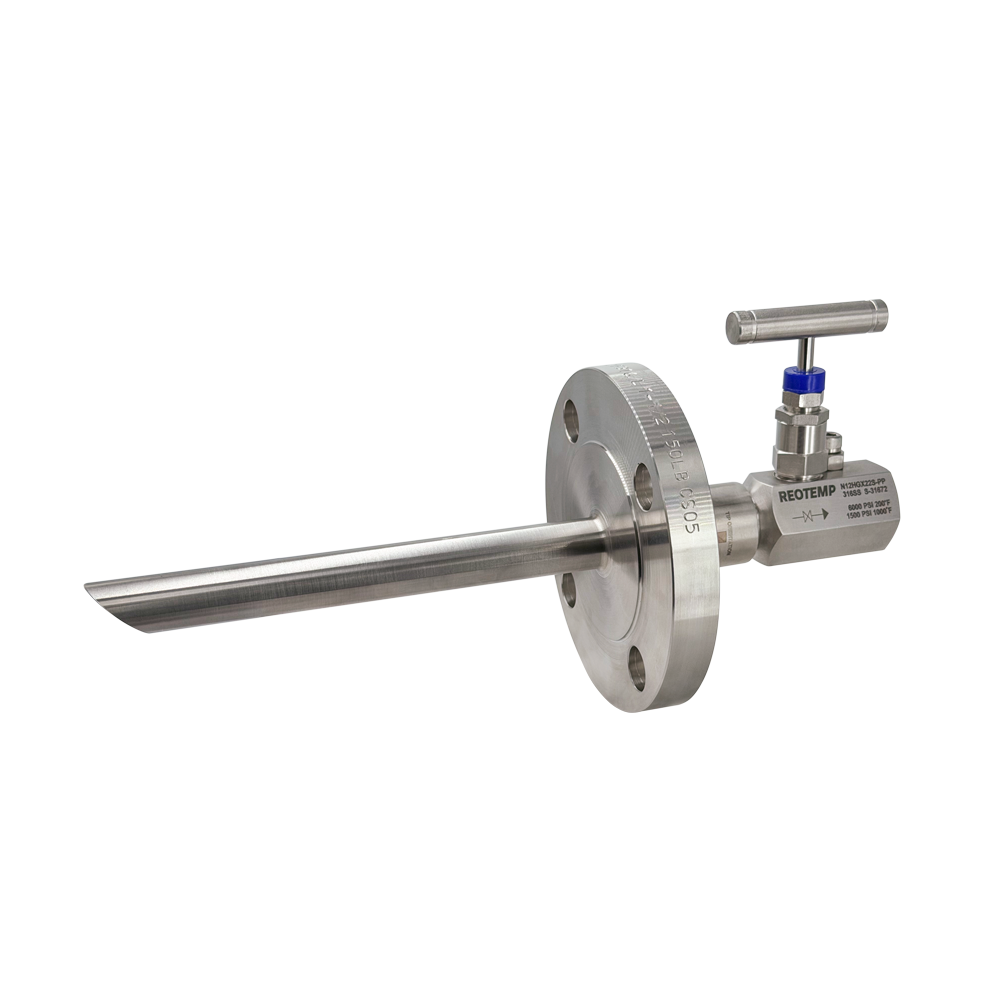
Built in several configurations
Quill & Probe Product Types
Reotemp machines injection quills and sample probes in several standard construction types. Each pairs with the process connection, isolation valve, and instrument head your line requires.
Threaded Quills
Economical NPT-connected quills for smaller pipe sizes and lower-pressure service, with a straight or 45 deg tapered tip.
Socket Weld Quills
Welded construction for higher-pressure, higher-cycle service where a threaded joint is not suitable for the application.
Flanged Quills
Bolted, raised-face flange connections for large-diameter pipe, high pressure, or applications that call for easier removal and reinstallation.
Quill & Valve Assemblies
Factory-assembled quill and valve combinations, including double block and bleed configurations, that let the quill be removed for service without a full line shutdown.
Check Valve Quills
Quills with an integral check valve to prevent backflow into the chemical feed line and protect upstream metering pumps from pressure surges.
Pressure & Temperature Quills
Combination assemblies that pair a quill with a pressure gauge or thermometer connection, reducing the number of penetrations into the pipe wall.
Reotemp Technical Reference
Understanding Quills & Sample Probes
Injection quills and sample probes look almost identical and share the same configuration choices, but they move fluid in opposite directions, and that changes the design.
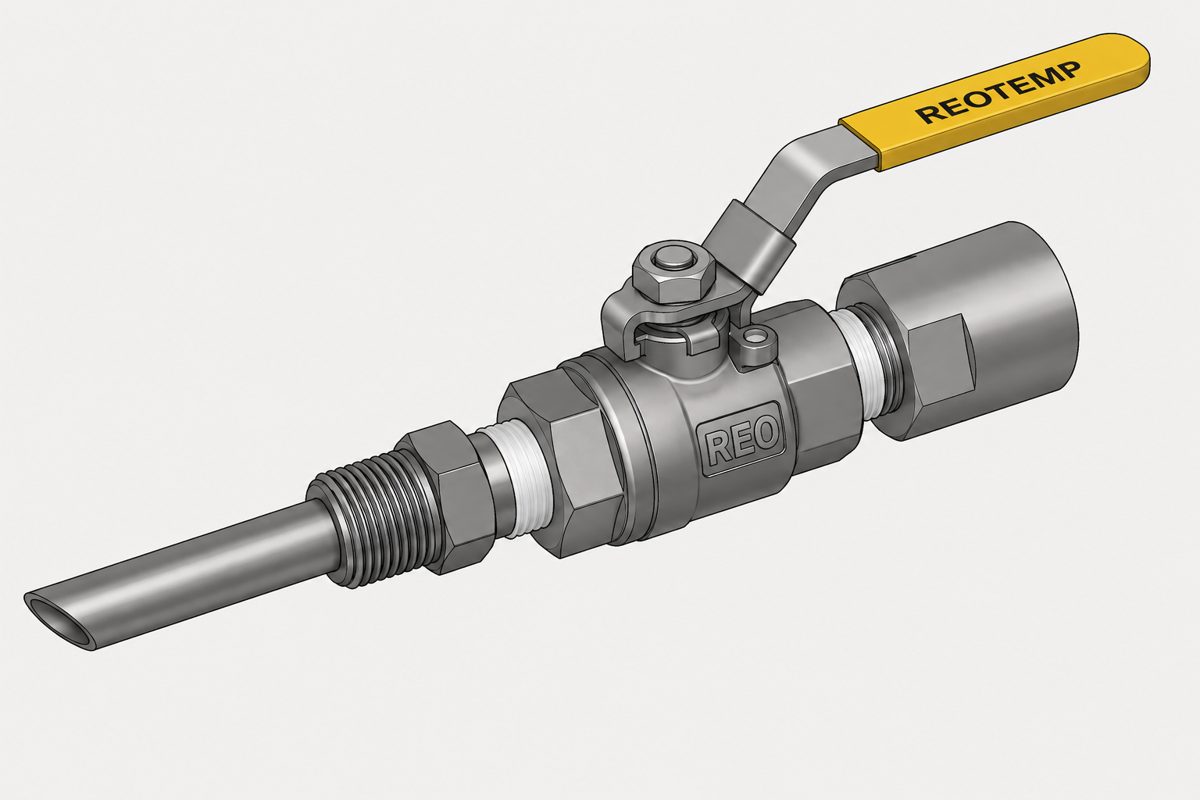
Injection quill
Puts chemical in
Delivers treatment chemical to the center of the process stream so it mixes immediately, instead of running down the pipe wall and corroding it.
- Discharges at the center of flow for even dispersion
- Often paired with a check valve to stop backflow
- Tip and bore sized to the dosing rate
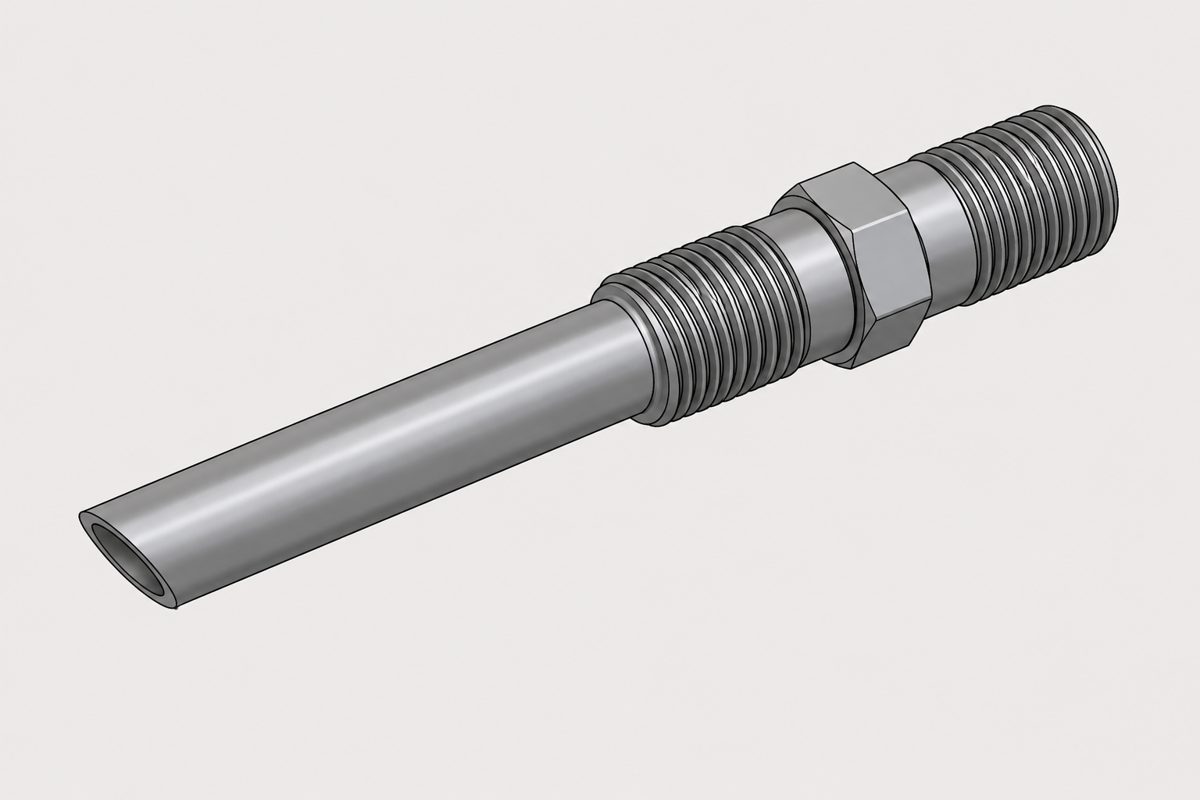
Sample probe
Takes fluid out
Withdraws fluid from mid-stream so the sample reaching your analyzer or lab represents the bulk flow, not the stagnant film at the wall.
- Draws from the center of flow for a true sample
- Isolation valve allows clean, safe extraction
- Geometry chosen to avoid dead zones
What does a quill actually do?
An injection quill or sample probe is inserted through the pipe wall so its open tip sits within the active flow path, rather than flush against the inside of the pipe. For injection service, this places the discharge point near the center of flow, so treatment chemical disperses evenly instead of running along the pipe wall, where it can cause localized corrosion or uneven treatment. For sampling, the same geometry lets the probe draw a representative sample instead of fluid that has settled near the wall.
Welded vs. retractable designs
Welded and flanged quills are fixed in place and offer the most durable, vibration-resistant construction, but they can only be removed during a line shutdown. Retractable designs use a packing gland to seal around the probe so it can be withdrawn for service while the line stays in operation, a common requirement for online process analyzers.
Design note: Probes are generally most effective in pipe sizes 2 in and larger, and are considered standard practice above 4 in. For best sampling and injection performance, industry guidance recommends roughly 10 pipe diameters of straight, undisturbed flow upstream of the quill and 2 pipe diameters downstream.
Key terminology
- Stinger / probeAlternate trade names for an injection quill or sample probe.
- Double block & bleed (DBB)Two isolation valves with a bleed valve between them, used to safely isolate and depressurize the quill for removal.
- Insertion length ("U" dimension)How far the probe extends into the pipe, measured from the process connection to the tip.
- Wake frequency calculationAn engineering check, similar to the thermowell method in ASME PTC 19.3, that confirms the probe will not resonate with flow-induced vortex shedding at process velocity.
- Wall streamingAn installation defect where injected chemical runs along the pipe wall instead of mixing into the flow, often caused by insufficient insertion depth.
Common questions
Injection Quill & Sample Probe FAQ
What is an injection quill used for?
What is the difference between an injection quill and a sample probe?
How do I determine the insertion length I need?
Where should a quill be installed in the piping?
What materials are available?
Does a quill need a check valve?
Can a quill be removed while the line is in service?
What pressure can these handle?
What affects the price of an injection quill or sample probe?
Ready to spec your quill or sample probe?
Your request goes straight to a Reotemp engineer for a quick response.
Request a Quote